Evaluating regional variation in neighbourhood socioeconomic inequalities in motor vehicle injury collisions
Dec 12, 2025·
 ,,,,,,,·
0 min read
,,,,,,,·
0 min read
Michael Branion-Calles
Somayeh Momenyan
Shannon Erdelyi
Herbert Chan
Kevin Manaugh
Meghan Winters
M. Anne Harris
Jeffrey R. Brubacher
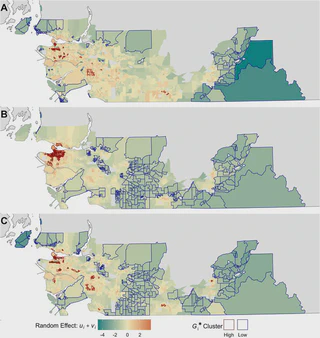 Regional grouping of census metropolitan and agglomeration areas
Abstract
Disadvantaged communities have higher rates of traffic injury. Our goal was to measure regional variation in the association between small-area socioeconomic deprivation and motor vehicle crashes resulting in injury within British Columbia, Canada. We analyzed road traffic injury crashes from universal auto insurance claims (2019–2023) across 16 urban regions of British Columbia, aggregated by census dissemination areas (DAs). We measured socioeconomic deprivation using the Vancouver Area Neighbourhood Deprivation Index, a normalized score combining seven health-related sociodemographic variables applied to the 2021 Canadian census. We examined associations between deprivation and three injury crash types (motor vehicle, bicycle-motor vehicle, and pedestrian-motor vehicle) using Bayesian spatial regression models. Increased socioeconomic deprivation was consistently associated with higher injury crash incidence across all crash types, with regional variation in the strength of the relationship. Among the most populous regions, a one standard deviation increase in deprivation was associated with injury crash increases from 17 % (95 % Credible Interval [CI]: 12 %–21 %) in Vancouver-Fraser Valley to 51 % (95 % CI: 36 %–68 %) in the Okanagan region. Similar patterns were observed for cyclist injuries, from 10 % (95 % CI: 4 %–16 %) in Vancouver-Fraser Valley to 64 % (95 % CI: 38 %–93 %) in Okanagan, and for pedestrian injuries, from 17 % (95 % CI: 11 %–24 %) in Vancouver-Fraser Valley to 77 % (95 % CI: 48 %–110 %) in Okanagan. Smaller regions had wide credible intervals and more uncertainty in associations. To address spatial inequalities, prioritization of the placement of road safety interventions should incorporate equity considerations, as well as area-level interventions that address fundamental risk factors of traffic volume and speed.
Type
Publication
Health & Place, 97 (103586)
